Loading map...
{"minzoom":false,"maxzoom":false,"mappingservice":"leaflet","width":"auto","height":"250px","centre":false,"title":"","label":"","icon":"","lines":[],"polygons":[],"circles":[],"rectangles":[],"copycoords":false,"static":false,"zoom":11,"defzoom":14,"layers":["OpenStreetMap"],"image layers":[],"overlays":[],"resizable":false,"fullscreen":false,"scrollwheelzoom":true,"cluster":false,"clustermaxzoom":20,"clusterzoomonclick":true,"clustermaxradius":80,"clusterspiderfy":true,"geojson":"","clicktarget":"","imageLayers":[],"locations":[{"text":"","title":"","link":"","lat":58.38,"lon":26.725,"icon":""}],"imageoverlays":null}
Tartu is the second largest city (150,139 inhabitants in 2013) of Estonia, center of the county of the same name in the southeastern part of the country. It is famous for the nation's oldest and most renowned university.
The ancient Estonian fortress of Tarbatu was founded in the 5th century AD. Historical names for the city include Russian Yuryev (Юрьев, from 1030) and later Derpt (Дерпт). The German and Polish Dorpat name first mentioned only from the 13th century.
Estonia
USSR era
Republic 1919-1940
Germany WW1 era
 1918 DORPAT cancel on Germania 7½ pf |
Empire of Russia
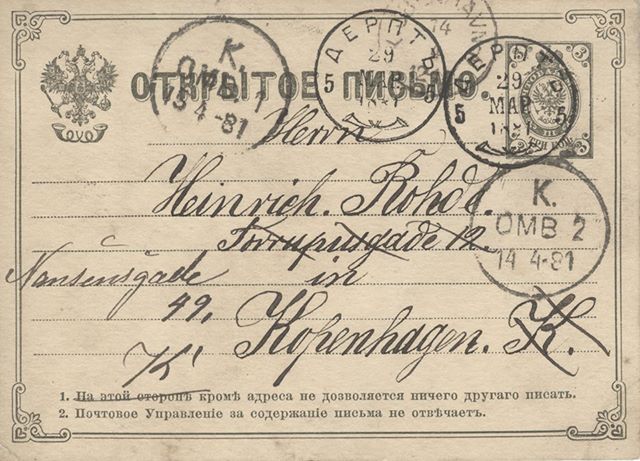 1881 Tartu to Copenhagen with K OMB 1 and K OMB 2 receiving handstamps. |
_cover_6_May_1957.jpg)

_GER_a.jpg)
_USSR_a.jpg)

_First_Republic_a.jpg)
_First_Republic_b.jpg)